Every product travels through four stages — introduction, growth, maturity and decline. A payment network is no exception. The interest of the model to a finance professional is not descriptive but predictive: each stage carries a different cost structure, a different cash-flow profile and a different set of decisions for everyone who depends on the product. The mistake most businesses make is to recognise a stage only after they have left it.
UPI is a useful case study because its stages are unusually well documented, and because the event that classical theory associates with the onset of decline — the withdrawal of subsidy and the arrival of price — has just been formally notified.
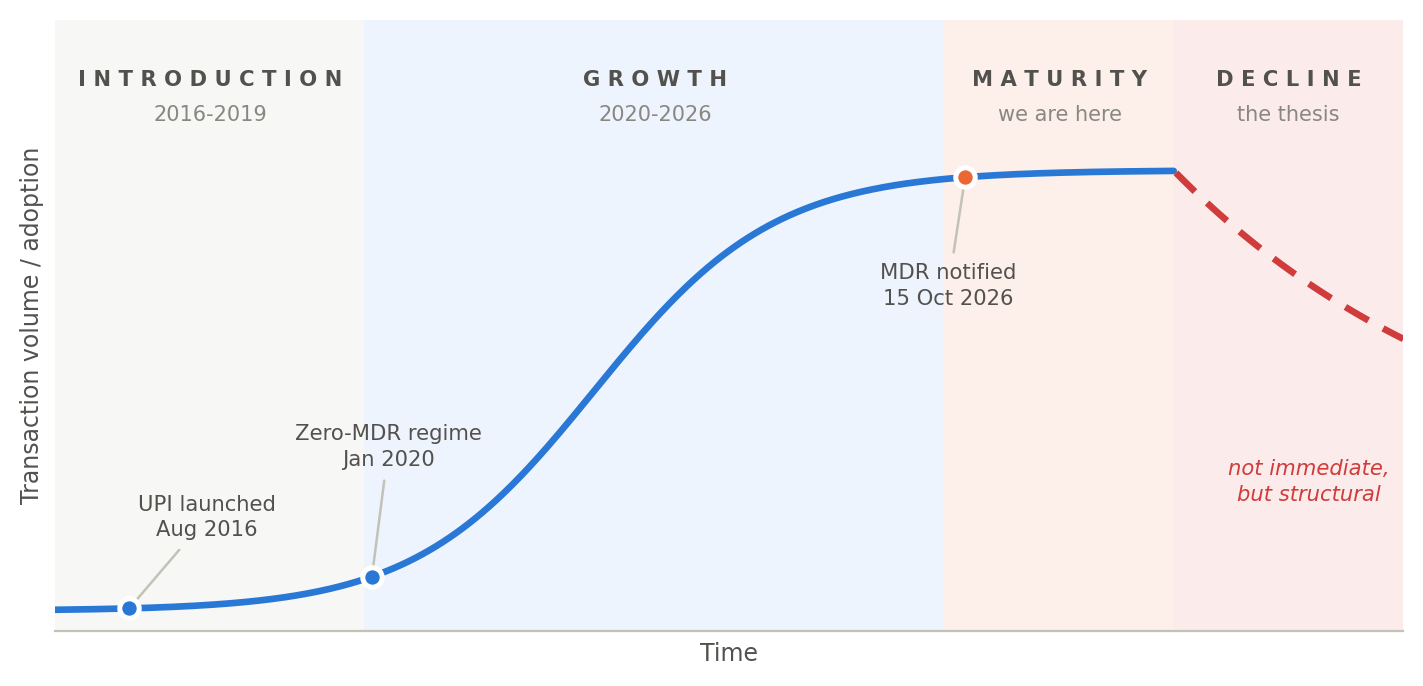
Stage 1 · Introduction (2016–2019)
UPI was launched on 25 August 2016. Its transaction value in FY17 was ₹0.07 lakh crore — statistically negligible. This is the classic introduction stage: heavy infrastructure spend, low adoption, negative unit economics, and survival dependent entirely on a sponsor willing to absorb losses. Here the sponsor was the State, and the strategic objective was not profit but the displacement of cash.
Stage 2 · Growth (2020–2026)
The growth stage began with a policy decision, not a technology one. In January 2020 the Payment and Settlement Systems Act was amended to make UPI and RuPay debit transactions free for merchants, with banks and fintechs compensated instead through an annual budgetary incentive. Price was removed as a barrier to adoption — textbook penetration pricing, funded by the exchequer.
The result is the steepest adoption curve in Indian financial history. In August 2026 UPI processed 24.51 billion transactions worth ₹29.82 lakh crore — its highest-ever monthly volume, averaging 791 million transactions a day across 752 live member banks, with acceptance now extended to eleven countries.
But growth and maturity are not the same thing
Maturity is not marked by falling numbers. It is marked by growth that changes character. Absolute volumes can keep setting records while the rate of growth quietly halves — and that is precisely what the data shows.
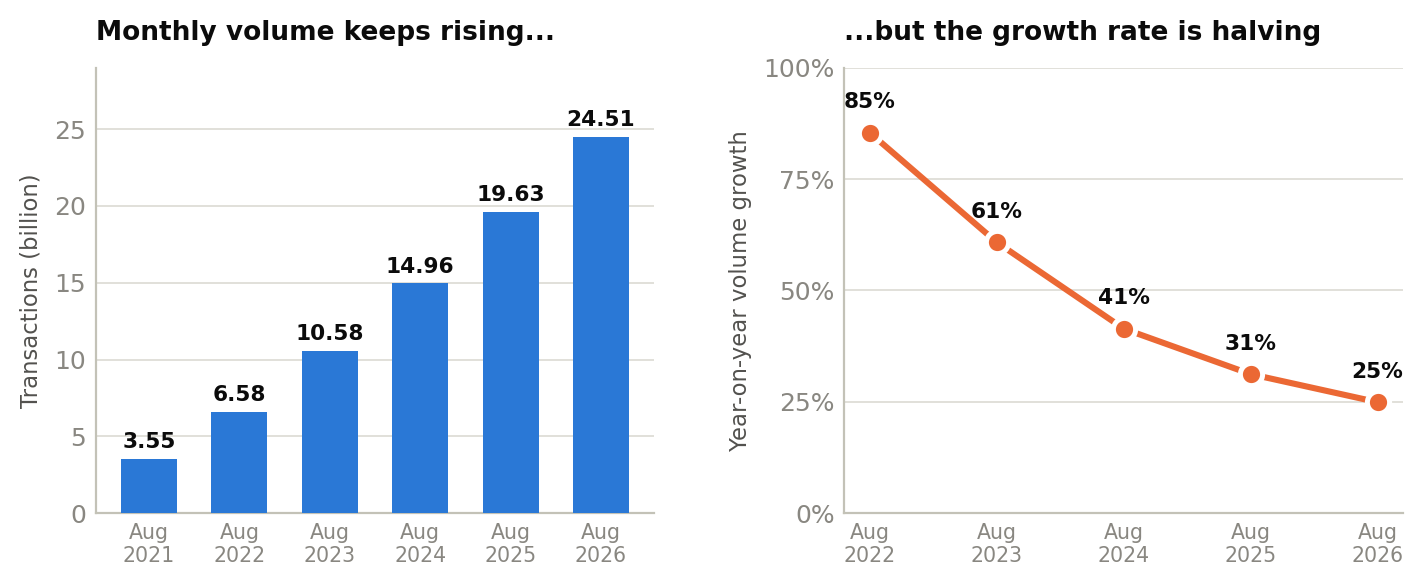
Each year UPI adds roughly the same absolute number of transactions — between 3 and 5 billion a month more than the year before. On a rising base, a constant absolute increment is a falling percentage. Year-on-year growth has fallen from 85% to 25% in five years. Extended on the same arithmetic, growth enters the teens well before the end of the decade. That is the signature of a product moving from growth into maturity.
Three further maturity signals
- Ticket sizes are falling. Volume rose 3.6% month-on-month in August 2026 while value actually fell 0.2%. More payments, smaller payments.
- The remaining headroom is low-value. The average transaction slipped to about ₹1,217 from ₹1,263 in July — the core high-value use cases are already captured, and incremental growth is coming from the kirana purchase and the auto fare.
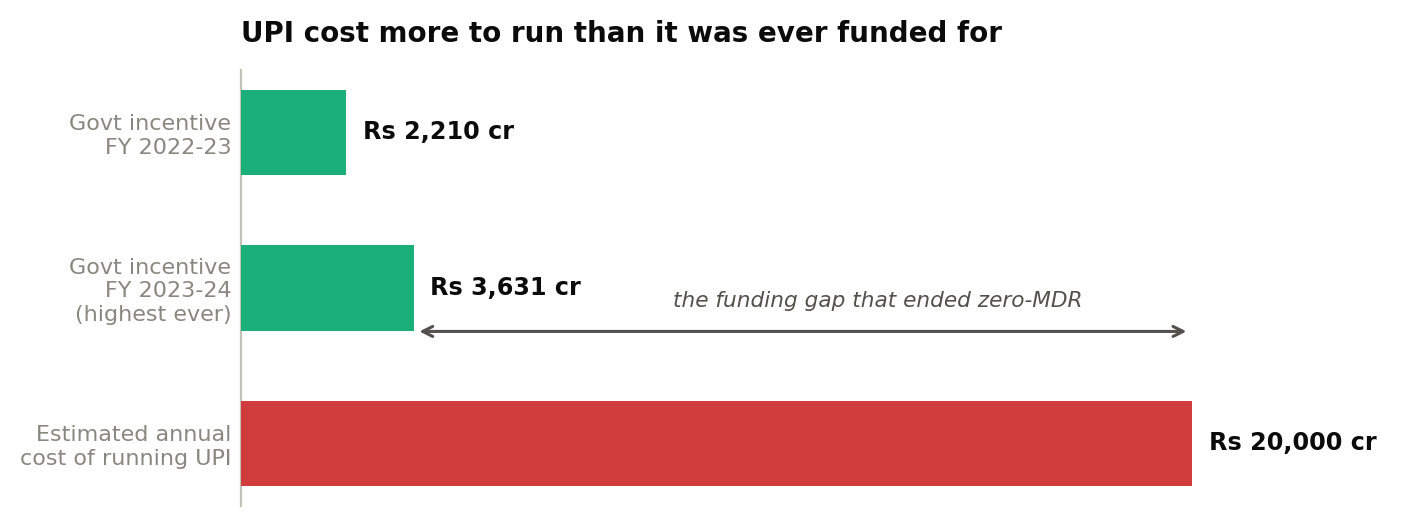
- The sponsor started asking who pays. Industry estimates put the annual cost of operating UPI at roughly ₹20,000 crore. The largest single-year government incentive ever paid was ₹3,631 crore, in FY 2023-24.
Stage 3 · The decline trigger — price enters the model
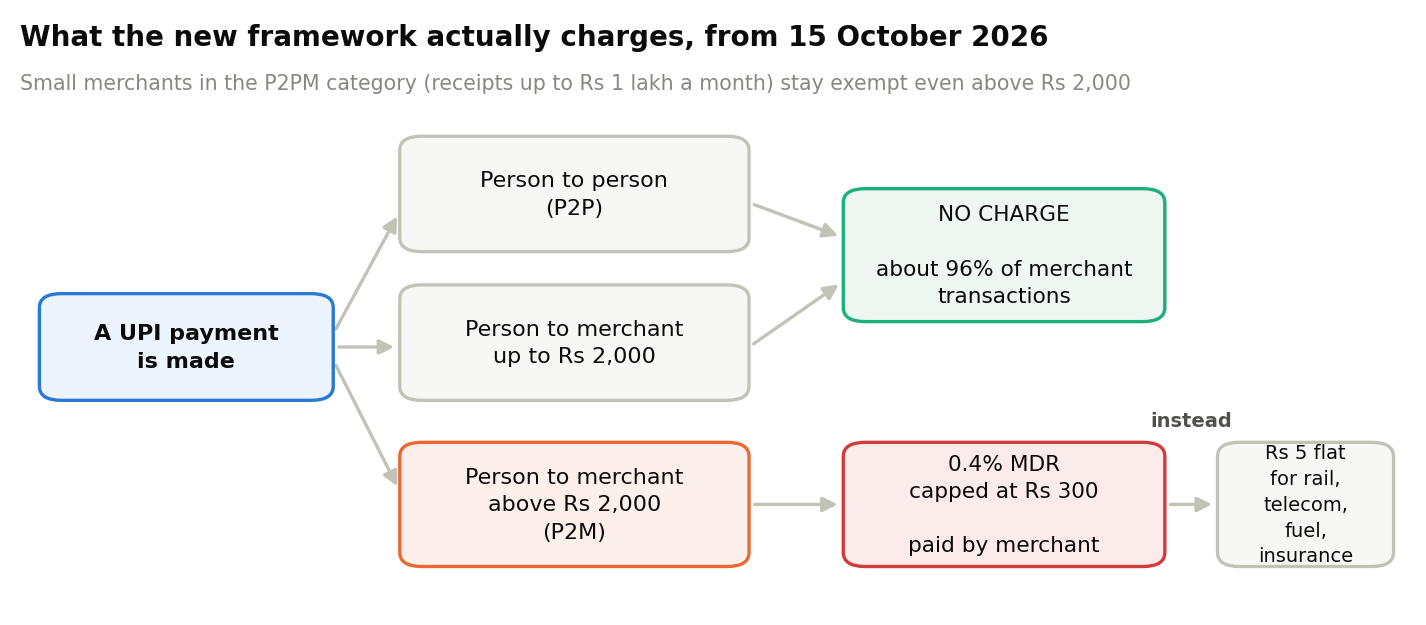
On 15 September 2026, NPCI notified a Merchant Discount Rate of 0.4% on person-to-merchant UPI transactions above ₹2,000, effective 15 October 2026. This ends the zero-MDR regime that had been in place since January 2020. The charge is borne by the merchant, not the consumer, and is capped at ₹300 for transactions of ₹75,000 and above. Railways, telecom, insurance and fuel attract a flat ₹5 instead. Merchants are barred from passing the cost to customers, and UPI apps are barred from adding a platform fee.
The enabling step came a month earlier: in August 2026 Parliament amended Section 10A of the Payment and Settlement Systems Act, giving the government authority to designate which UPI transactions remain free without returning to Parliament each time. That procedural change matters more than the headline rate.
Why this supports a decline thesis
- Subsidy withdrawal is the classical decline marker. Growth purchased by price suppression reverses when price returns. The ₹2,000 threshold and the 96% exemption are today's parameters, not permanent ones — and Section 10A has deliberately made future revision an executive act rather than a legislative one. Threshold creep is the risk to watch, not the current rate.
- Merchant economics turn at the high end. On a thin-margin trade, 0.4% on a ₹50,000 invoice is ₹200 of pure cost against a gross margin that may itself be 2–3%. The rational merchant response is to steer high-value customers toward NEFT/RTGS, cash, or a direct account transfer outside the UPI rails.
- The bar on passing costs through is hard to enforce at the margin. A merchant who cannot legally add a surcharge will instead quote a discount for cash. The distortion survives; it simply becomes invisible to the regulator.
- A priced network invites substitutes. Once UPI is no longer definitionally free, competing rails — cards, wallets, account-to-account transfers, whatever follows — compete on price rather than against zero. That is a materially different competitive landscape.
The enforcement gap nobody has priced
A rule that says the merchant may not recover the MDR from his customer assumes a merchant who reads notifications. A very large part of India's retail counter does not. The vegetable seller at the market, the tea stall, the small hardware shop — these are businesses run on net realisation, not on compliance literacy. The proprietor does not ask what Section 10A permits. He asks what reached his account against what he handed over the counter. If money goes missing between the two, the price goes up, or the QR code quietly comes off the wall. No circular alters that arithmetic.
Two consequences follow, and neither of them will be visible in NPCI's monthly data.
- Perception travels faster than the notification. Most of these vendors are in fact exempt — the P2PM category covers receipts up to ₹1 lakh a month, so the vegetable seller is outside the charge altogether. But what reaches him is "UPI has charges now", not the threshold and not the exemption. A merchant who believes he is being charged behaves exactly like one who is. The rupee added to the price, or the quiet request for cash, costs the ecosystem the same either way.
- The recovery is untraceable. A formal merchant who surcharges leaves a record, and a customer who is surcharged has somewhere to complain. An informal one simply prices differently — ₹52 where it was ₹50, or a discount for cash that was never written down anywhere. There is nothing for a regulator to detect.
This is where the decline thesis has its firmest footing. Not in the arithmetic of 0.4%, which is genuinely small, but in the behaviour of several crore merchants who will respond to what they believe the charge to be — and who came to UPI in the first place precisely because it cost them nothing at all.
The honest counter-argument
Professional judgement requires stating what would invalidate the thesis, and here the counter-case is substantial.
The exemptions are wide. P2P transfers and merchant payments up to ₹2,000 stay free, and micro-merchants in the P2PM category — receipts up to ₹1 lakh a month — remain outside the net even above the threshold. On the government's own estimate that leaves roughly 96% of merchant transactions untouched. The fee is also degressive rather than progressive: because of the ₹300 cap, the effective rate falls as the ticket rises.
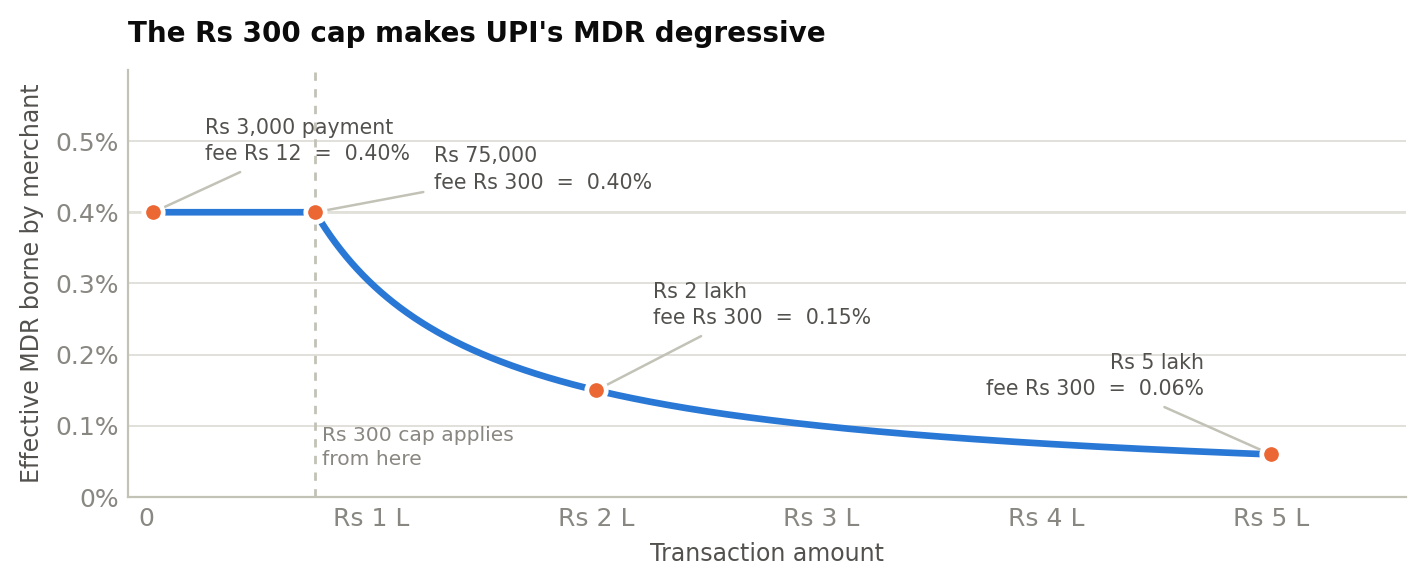
Network effects are also brutally sticky. A merchant who declines UPI loses the sale, not merely the fee. Historically, decline in payment networks comes from technological substitution, not from a 40-basis-point charge. On the evidence available today, the more probable near-term outcome is an extended maturity with margin compression — a long, and for the ecosystem a profitable, plateau — rather than a fall in volumes.
Conclusion
UPI is best read today as a product at the inflection between growth and maturity, with the pricing event of 15 October 2026 marking the formal end of its subsidised growth phase. Decline, if it comes, will not come this year, and it will not come from the 0.4% itself. It will come — if at all — from two things the notification cannot control: the precedent now established, that the fee exists, that the threshold is executive-determined and that the ₹20,000 crore funding gap has not gone away; and the response of a merchant base that will price on what it believes, not on what the circular says. Price, once introduced to a product, rarely travels in one direction — and belief, once formed, is harder to withdraw than a levy.
What this means in practice
- Model the MDR cost into pricing wherever collections routinely exceed ₹2,000 per transaction.
- Review your collection mix — what share of receipts sits above and below the ₹2,000 line, and whether splitting or aggregating invoices changes the position.
- Verify your merchant classification. P2M and P2PM carry different consequences, and the ₹1 lakh monthly receipt test decides which applies.
- Note that GST follows MDR. Where no MDR was charged, no GST arose on it; where MDR becomes chargeable, the GST question follows it.
- For businesses with large-ticket collections, the ₹300 cap makes UPI cheaper than cards at the top end — the strategic response may be to route more high-value collection through UPI, not less.
References
All transaction data is from NPCI monthly releases as reported in the sources below. Figures 1 to 5 are the author's own analysis of that published data.
- NPCI — UPI Product Statistics (official monthly data)
- Business Standard — UPI fee: Why government is putting a price on big merchant payments (16 Sep 2026)
- Business Standard — UPI sets new record at 24.51 bn transactions in August 2026
- Outlook India — UPI payments above ₹2,000: What changes from October 15
- The Wire — New levies on some UPI transactions will kick in next month
- Medianama — UPI August 2026 data: 24.51 billion transactions, value dips
- Medianama — UPI records 14.96 billion transactions in August 2024
- Business Standard — India clocks 10 billion UPI transactions for the first time in a month (Aug 2023)
- Business Standard — At 3.5 billion transactions in August, UPI clocks 120% surge in volume (Aug 2021)
- The Tribune — Government incentive scheme outgo on UPI (FY23 and FY24 figures)
- PIB — UPI completes 10 years: world's largest real-time payments platform
This article is for general information and does not constitute professional advice. Positions stated reflect the framework as notified on the date above and may change.
← Back to Insights