During the gas shortage, small shops and eating places put up boards. The wording varied, but the message was the same: because of the gas situation, a few rupees extra. Nobody argued. Everybody had read the news. The shortage was real, and the reason was fair.
Some months later the gas situation eased. The queues disappeared. The boards came down.
The prices did not.
The board was temporary. The price it announced was permanent.
That is not a scandal, and nobody did anything wrong. It is how prices behave — and it is worth understanding, because it is happening across a whole household's shopping right now, and most of it is invisible until you go looking for it.
Start with the shopping bag, not the headline
Retail inflation for August was reported at 4.82 per cent. Food was a little higher, at 5.95. Those are calm numbers, and if your own experience has not felt calm, the explanation is not that somebody is lying. It is that an average is a poor description of a household.
Take the plainest possible measure of what a home actually spends: the cost of putting a simple vegetarian meal on the table. Over the twelve months to August, that cost went from about twenty-nine rupees to twenty-nine and a half. A rise of roughly one per cent. On the face of it, nothing happened at all.
Now look at what the plate is made of.
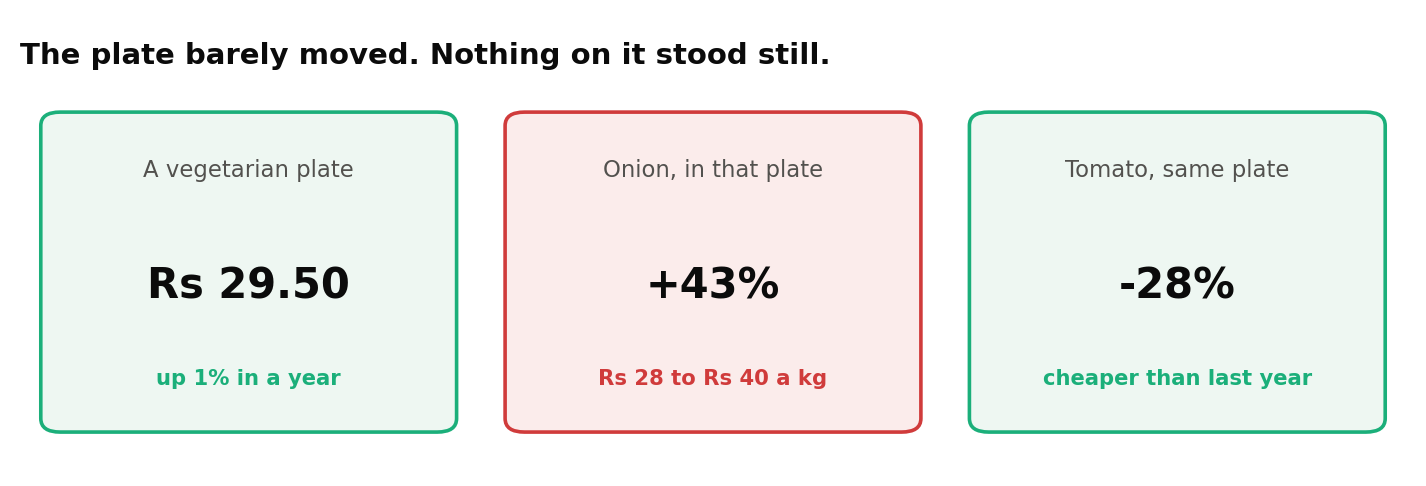
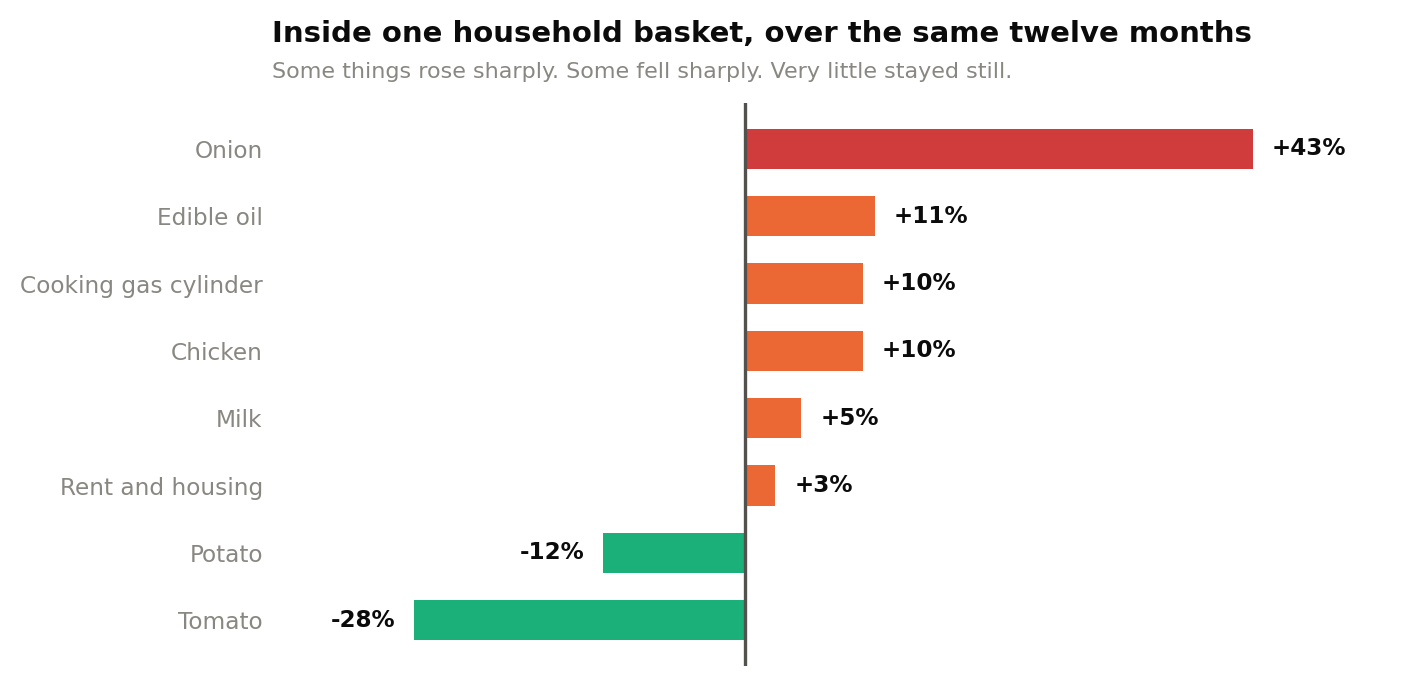
Onion went up forty-three per cent, from twenty-eight rupees a kilo to forty. Tomato fell twenty-eight per cent. Potato fell twelve. Edible oil rose eleven, the cooking gas cylinder ten, chicken ten. Milk rose about five.
Every single item moved, several of them violently, and they moved in opposite directions. The plate came out almost unchanged because the increases and the decreases cancelled each other out inside it.
Why this is the whole story
A household does not buy the average. It buys particular things, in particular proportions. A family that cooks with a lot of onion and buys a cylinder every month had a hard year. A family that eats more tomato and potato had an easier one. Both of them live inside the same one per cent.
So when the published figure and your own sense of things disagree, both can be right. The index is a national summary. Your month is not.
The small numbers that are not small
There is a second reason the damage is easy to miss, and it has nothing to do with statistics. It is that everyday prices move in amounts too small to argue about.
A ten rupee cup becomes fifteen, and later twenty. A plate of idli goes up five rupees, then another five. A packet of milk goes up two rupees, twice in a year. None of these is worth a conversation at the counter. Nobody walks out over five rupees.
But five rupees on ten is fifty per cent. Twenty against the original ten is a hundred. Two rupees twice on a thirty rupee packet is thirteen per cent in a year, which is roughly three times the headline rate. The small denomination is exactly what makes the increase survivable — and therefore permanent.
The habit worth building is simple: when a price rises by an amount too small to mind, work out the percentage before deciding it is small.
What actually happened to the oil
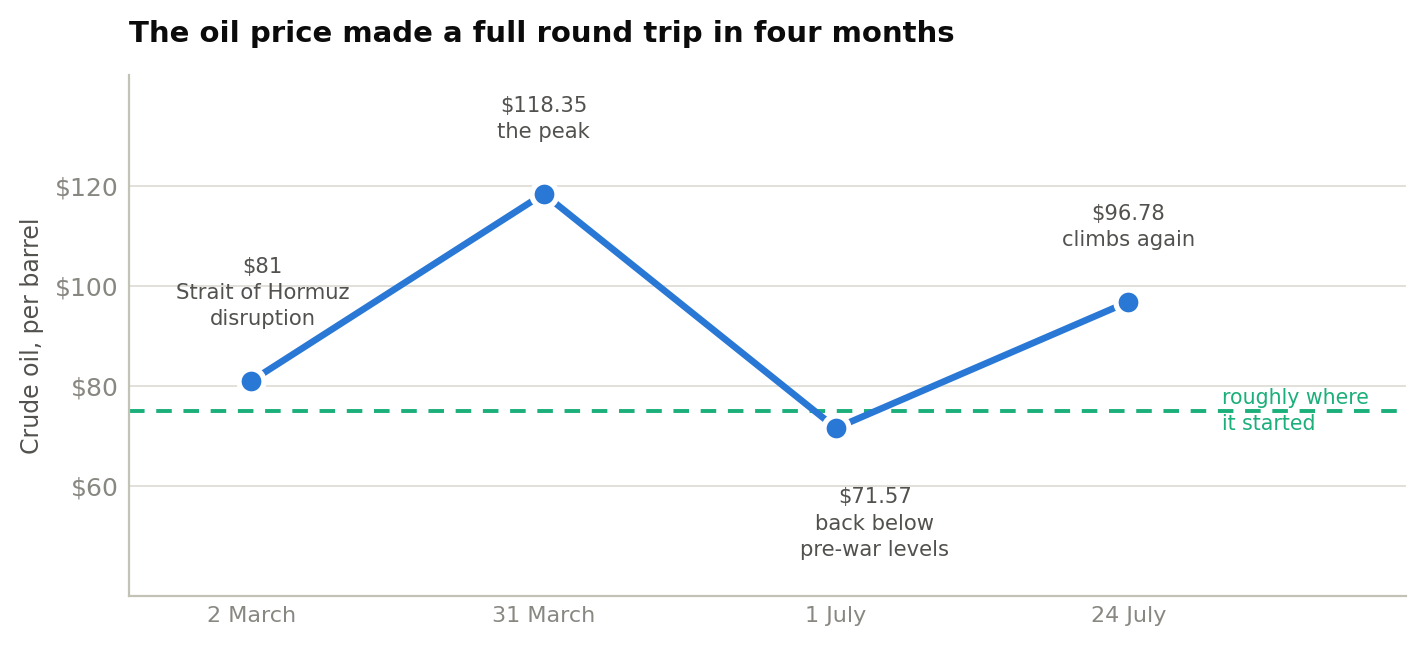
The trigger was a long way from any kitchen. A war in West Asia disrupted the Strait of Hormuz, through which a very large share of the world's oil and gas passes. Crude, which was in the region of eighty dollars a barrel, went to a hundred and eighteen. An attack on a major gas facility pushed Asian spot gas prices up by well over a hundred per cent.
Households felt it immediately. There were queues for cooking gas. Deliveries ran late. Some people went back to kerosene and firewood. This was not an Indian event — it ran through every country that buys its energy by sea.
Then the ceasefire came, shipping settled, and the oil price came all the way back down. By the first of July it was below where it had been before the war started.
So the honest question is the one most people asked at some counter or other: the shortage is over, so why has nothing gone back to what it was?
Why the shopkeeper is not lying
Part of the answer is that his costs genuinely did not come back down.
A household cooking gas cylinder and the one a small business uses are two different products. The domestic cylinder is cushioned — its price is held steady for long stretches and the government absorbs the difference. The large commercial cylinder, which is what a sweet shop, a bakery, a small hotel or a roadside kitchen burns through, has no such cushion. It is repriced every month against international rates.
That commercial cylinder has kept climbing, and went up again on the first of October. So when a shopkeeper says his costs have not fallen, he is telling the truth. The cylinder that made the news is not the cylinder he buys.
And part of the answer is simply how prices work
Prices rise easily and fall reluctantly. Economists have a name for the cost of changing a price — they call it a menu cost, after the expense of reprinting a restaurant's menu. Here the menu was a board. Putting it up cost almost nothing. Taking it down cost nothing either. But the price it announced had, by then, become the ordinary price.
There is a second reason, and it is the one most people have watched happen without putting a name to it. A visible crisis gives every shop permission. The first shop to raise its price takes whatever resentment there is — and it has a reason to point at, so there is not much. Once that shop survives it, the next one follows at no risk at all, because the customer has already accepted the explanation. By the fourth shop, nobody even asks.
Then the crisis ends. But the reason was never really the reason. It was permission. And permission does not expire, because by the time the shortage is over, the new price is simply what the thing costs.
A situation creates an opportunity, and business moves faster than the situation does.
The same thing, at the other end of the chain
If this were only about shopkeepers, it would be a small story. It is not. The same pattern appears at the very start of the chain, where nobody is selling anything to anybody over a counter.
The cost of imported urea fell by well over half between May and September — from around nine hundred and fifty dollars a tonne to around four hundred. An enormous fall in an essential farm input.
The price the farmer pays for his urea did not change. It is fixed, so the saving went to the government's subsidy account instead. Which is a perfectly reasonable arrangement — but it means that when the input got cheaper, nothing got cheaper for the person buying vegetables either.
Input prices fell at the refinery, at the gas terminal and at the fertiliser port. Nothing fell at the counter. That is the pattern, and it repeats wherever you look.
Everything is connected to everything
It helps to stop thinking about individual prices and start thinking about chains.
Diesel is not just a fuel. It is the cost of moving a tomato from the field to the market. When diesel rises, every vegetable in the country rises a little, whether or not anything happened to the vegetable. Fertiliser is not just a farm input. It is next season's food supply. Cooking gas is not just a kitchen expense. It is the production cost of every meal sold outside a home.
And there is now a second chain running alongside the first, which has nothing to do with any war.
The weather chain
This year's monsoon came in roughly thirteen per cent below normal — the weakest in years — under a strong El Nino that forecasters expect to persist into early next year. Reservoirs are at about seventy-one per cent against a ten-year average of eighty. Regions producing a large share of the country's onions, pulses and rice recorded serious rainfall deficits. Onion prices have roughly doubled over the year.
Less rain means less fodder and less water. Cattle feed now costs fifteen to twenty per cent more than it did a year ago. Feed that expensive means farmers keep fewer animals, and fewer animals mean less milk. Raw milk is already running around thirty per cent above last year, and dairies have signalled a further rise of a rupee or two around the festival season.
Now notice where the two chains meet.
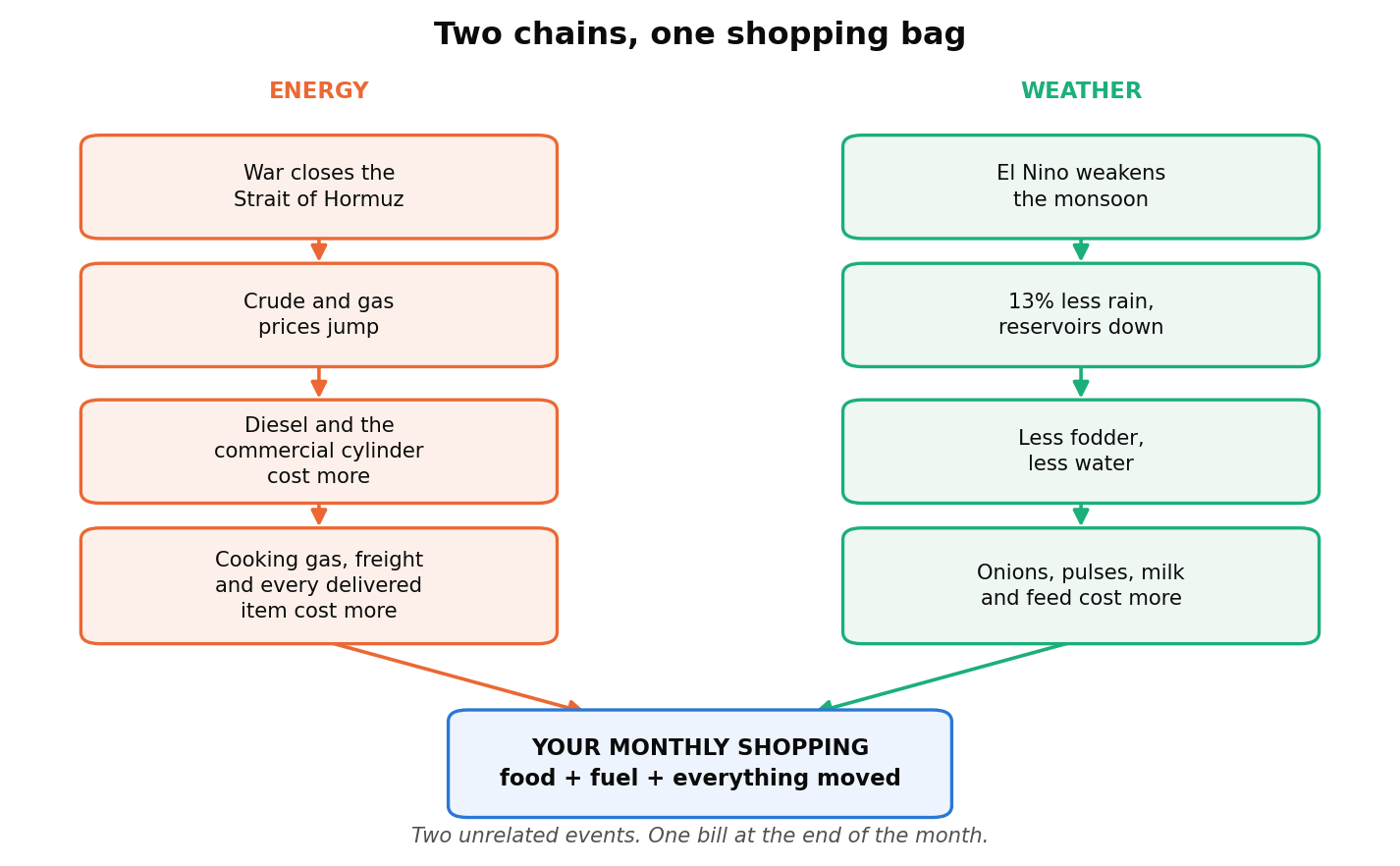
Go back to that vegetarian plate and you can see both chains sitting on it. The cooking gas and the transport came from the war. The onion and the milk came from the weather. The rice and the oil carry a little of each. Nothing on the plate was caused by anything that happened on the plate.
The quiet consequence: borrowing
When regular expenses rise faster than income, the gap has to be filled from somewhere. Increasingly it is being filled with small, fast loans.
Digital lenders sanctioned around 3.4 crore personal loans in a single quarter, with an average size of under nineteen thousand rupees. Close to three-fifths of that lending went to borrowers under thirty-five, and roughly two-fifths to smaller towns. These are not loans for houses or cars. At that size, they are loans for getting through the month.
This is the part of the story that rarely makes the front page, and it is the part that matters most. A price rise you absorb by borrowing has not been absorbed. It has been postponed, with interest attached.
What the Reserve Bank did this morning
On the morning of 7 October the Monetary Policy Committee raised the repo rate by a quarter of a percentage point, to 5.50 per cent. It is the first increase after four meetings of holding steady, and the stance was changed to what the Reserve Bank calls calibrated tightening — the Governor's words were that the next move can only be a hike or a pause. A cut is off the table for now.
The forecast matters more than the rate. The Bank raised its inflation projection for the year to 5.2 per cent, and expects the current quarter to run at around 6 per cent. Among the reasons it listed were the deficient monsoon, El Nino, and the volatility in international oil prices.
The central bank has named the same two chains — the weather and the oil.
Which is the useful thing to take from it. The connection between a failed monsoon, a distant war and the price of an ordinary week's shopping is not a theory anyone has to be persuaded of. It is the stated reasoning of the institution that sets the country's interest rates.
What a quarter of a per cent actually costs
A rate rise is how the Reserve Bank tries to slow prices down. It also arrives in your own budget, and it arrives in exactly the same disguise the five-rupee increases did — as a number too small to argue with.
Nobody panics at 0.25 per cent. On a floating-rate home loan it might mean a few hundred rupees more a month. But a loan runs for twenty years, and the small number runs for twenty years with it.
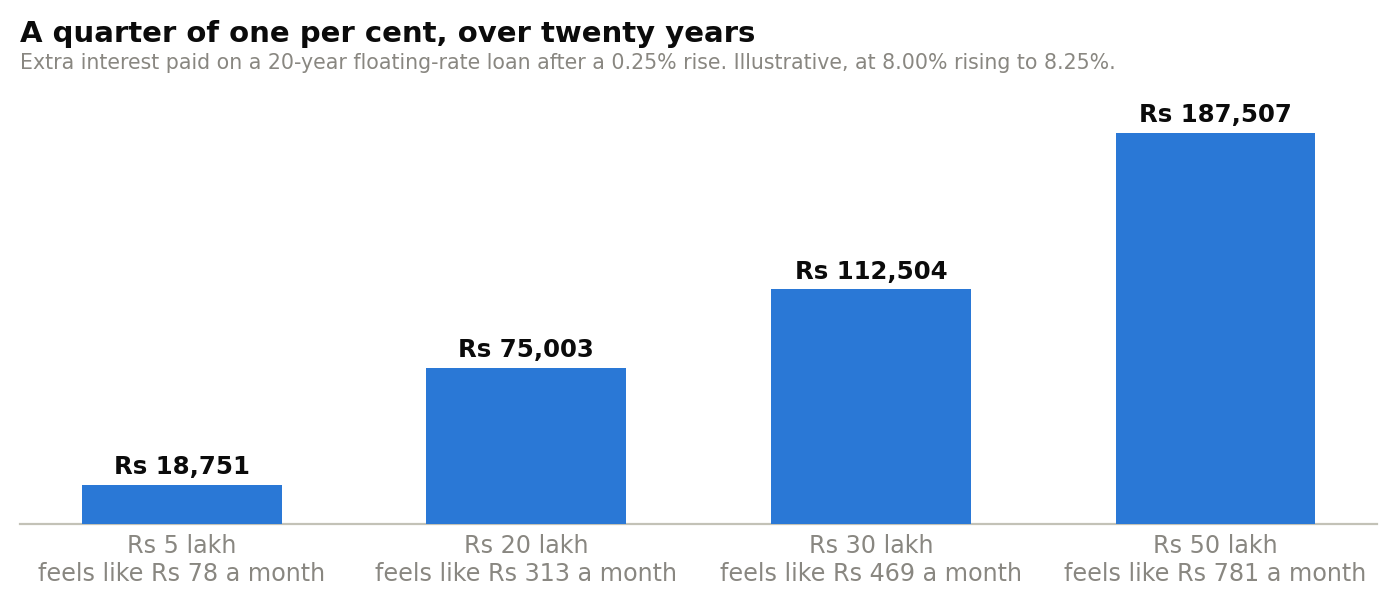
Four hundred and sixty-nine rupees a month is nothing. One lakh twelve thousand rupees is a year of school fees. They are the same number, looked at over different lengths of time — which is the same trick the five-rupee increases play in the shopping bag, applied to the largest thing most households ever buy.
And if borrowing is what has been covering the gap between prices and income, this is the moment that becomes expensive. Rates have turned. For anyone carrying short-term or revolving debt, this is the point at which clearing the costliest loan first stops being good advice in general and starts being good advice right now.
What to watch, and why it is worth watching
The point of all this is not to be gloomy. It is that a price rise is visible long before it reaches you, if you know where to look.
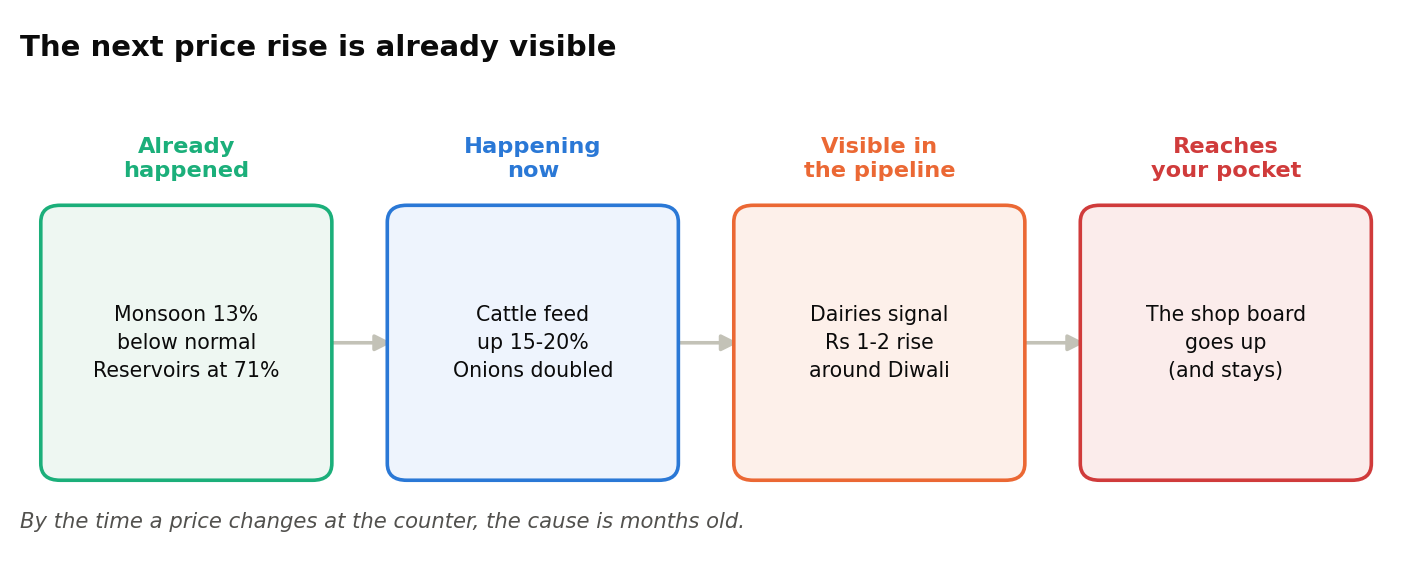
The rain that did not fall in June is the milk price in December. The ship that did not sail in March is the cylinder price today. Between the cause and the counter there is usually a gap of several months — and that gap is the only warning anyone gets.
Six things worth keeping an eye on
- Cooking gas, the commercial cylinder in particular. It is repriced monthly and it moves before anything you eat outside the home does.
- Diesel. It is not one price; it is a part of every price that has to be transported.
- The rabi sowing and reservoir position over the coming weeks. That is next spring's food bill being decided now.
- When a board goes up in a shop, note the date. The reason will pass. Check in six months whether the price did.
- Your own loan rate. With the stance now on tightening, a floating rate will reset upward. Clearing the most expensive borrowing first matters more this year than last.
- Your own ten most-bought items. Write down what they cost today. In six months that list will tell you more about your household than any published figure can.
None of this is a reason for gloom. It is a reason to look at your own basket rather than the national one, because the national one is not describing your month — and because the next increase is already on its way, visible to anyone who cares to look for it.
Sources
- Ministry of Statistics — CPI release, August 2026 (retail inflation 4.82%, food 5.95%)
- 2026 Iran war fuel crisis — timeline, crude and LNG price movements
- CNBC — timeline of how the Iran war moved oil prices
- Business Standard — commercial LPG and ATF price revision, 1 October 2026
- Department of Fertilisers data — urea import cost falls 57% from May peak
- Monsoon 2026 deficit, reservoir levels and El Nino outlook
- Business Standard — milk prices to stay elevated; feed costs up 15-20%
- Outlook Business — dairy price revision and input cost pressures, 2026
- Business Today — digital lending volumes and average ticket size, Q1 FY26-27
- India's revised CPI series — 2024 base year and basket weights
- Business Standard — RBI MPC raises repo rate 25 bps to 5.50%, stance to calibrated tightening (7 October 2026)
Retail prices described in this article are everyday observations recorded for illustration. They are not survey data and are not presented as such.
Official statistics are cited as published. Any price index is a weighted average across many households; it is a national summary rather than a measure of an individual household's experience.
This article is for general information and does not constitute professional advice.
← Back to Insights